Nov 25, 2023
CIIP
Education
CIIP Chronicles: Exploring 'Communication' in Imaging Informatics
Welcome to another installment of our CIIP Chronicles series. Today, we're tearing into the 'Communication' domain of the CIIP Test Content Outline, which accounts for 7 of the 130 questions on the CIIP exam.
Introduction: The Underrated Powerhouse of Communications
In the labyrinth of imaging informatics, it's seductively easy to get hypnotized by the shiny new tech toys and the Byzantine data analytics. But here's the unvarnished truth: the reallinchpin in this high-octane arena is communication. Buried under all that tech glitter is the muscle of the operation. In the Communications domain of the CIIP Test Content Outline, we're not just seeing a marriage of tech chops and human finesse; we're witnessing a powerhouse at work. This is where the rubber meets the road: turning dense data into conversations that resonate, morphing numbers and images into insights that drive action.
This isn't your average blog post. No, we're doing a deep, no-holds-barred dive into the layered, gritty world of communication in imaging informatics. We're throwing a spotlight on the unsung hero, tearing apart its critical role in the CIIP ecosystem. Strap in; this isn't just interesting—it's a full-throttle, eye-opening ride into the heart of what makes imaging informatics tick. Let's get down to business and dissect how communication, this underdog, is actually the secret weapon in the CIIP arsenal. Prepare to have your mind blown.
1. Roles and Relationships in Healthcare Settings: The Human Network
The Diverse Cast of Healthcare: In imaging informatics, understanding the roles of CMIOs, department chairs, residents, and other key players is essential. Each role carries specific responsibilities and expectations in communication. For example, a CMIO (Chief Medical Information Officer) acts as a bridge between medical and IT departments, translating clinical needs into technical solutions.
The Setting Shapes the Story: Different healthcare environments, from bustling academic hospitals to focused private practices, set the stage for varied communication dynamics. In academic settings, for instance, communication often intertwines with education, requiring clarity and comprehensiveness for learners. In contrast, private practices might emphasize efficiency and succinctness in interactions.
Specialties Speak Volumes: Each medical specialty, be it radiology or oncology, brings its lexicon. Understanding the language of each specialty is vital for precise and effective communication. For instance, radiologists need to convey complex imaging findings in terms understandable to clinicians from various specialties, ensuring accurate and efficient patient care.
2. Medical Terminology: Speaking the Language of Imaging
Decoding the Anatomy of Communication: Having a solid grasp of medical terminology, particularly in anatomy, physiology, and pathology, is the bedrock of clear communication in imaging informatics. This knowledge ensures that discussions about imaging findings are accurate and free from ambiguity.
For instance, understanding terms like axial, sagittal, and cor
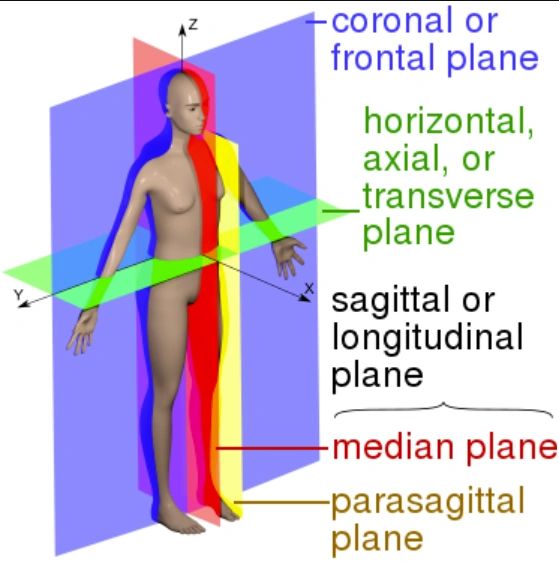
Images Planes - source wikipedia
onal planes is crucial in describing the orientation of imaging slices. The axial plane, also known as the transverse plane, divides the body into top and bottom halves, commonly used in CT and MRI scans to provide a cross-sectional view. The sagittal plane slices the body into left and right halves, essential for visualizing structures in the spine or assessing asymmetries. The coronal plane, slicing the body into front and back, is pivotal in examining the anatomy in a frontal view, often used in both MRI and CT scans.
This comprehensive understanding of medical terminology allows imaging professionals to communicate intricate details of imaging studies effectively, ensuring that clinicians can interpret the findings accurately for optimal patient care.
Positioning and Planes – A Visual Language: A profound understanding of imaging positions and planes is not just about technical accuracy; it's a language that enables precise and effective communication in imaging studies. This knowledge is crucial for ensuring error-free discussions and clear interpretations.
For instance:
· Supine Position: Commonly used in MRI and CT scans, this position involves the patient lying on their back. For example, a brain MRI in the supine position allows for a detailed examination of cerebral structures.
· Prone Position: The patient lies face down. This is often used in spinal imaging to get a clearer view of the spine and surrounding structures, as it can reduce the curvature of the spine compared to when the patient is supine.
· Lateral Position: The patient lies on their side. This position can be useful in chest X-rays to examine the lungs and pleural spaces. For instance, a lateral chest X-ray can help in assessing lung pathology that may be obscured in a standard anterior-posterior view.
· Fowler's Position: A semi-upright sitting position, often used in echocardiograms or during certain interventional radiology procedures. This position can aid in reducing the pressure on the back and is useful for patients who have difficulty lying flat.
· Trendelenburg Position: Involves tilting the patient's body with the head lower than the feet. This position can be used in emergency settings or for specific vascular imaging procedures to enhance blood flow in certain areas.
The Alphabet Soup of Coding in Imaging Informatics: Navigating the complexities of various coding systems, such as ICD, CPT®, SNOMED, RADLEX™, and LOINC, is a vital communication skill in imaging informatics. These codes are more than just administrative tools; they represent the universal language of medical conditions, procedures, and diagnostics, facilitating clear and consistent communication across different healthcare systems and providers.
· ICD (International Classification of Diseases): This coding system is primarily used for standardizing the classification of diseases and a wide range of health conditions. It's crucial for epidemiological tracking, health management, and billing purposes. For example, an ICD code helps in categorizing a patient's diagnosis of lung cancer, facilitating accurate record-keeping and insurance billing.
· CPT® (Current Procedural Terminology): Developed by the American Medical Association, CPT codes are used to describe medical, surgical, and diagnostic services. They are essential for billing and administration, helping to standardize the language around procedures and services provided by healthcare professionals. For instance, a specific CPT code would be used to denote a particular type of MRI scan.
· SNOMED CT (Systematized Nomenclature of Medicine - Clinical Terms): This comprehensive, multilingual clinical healthcare terminology provides codes, terms, synonyms, and definitions used in clinical documentation and reporting. SNOMED CT supports the electronic exchange of clinical health information, ensuring that healthcare data is interoperable and clinically valid.
· RADLEX™:Specifically designed for radiology, RADLEX™ is a lexicon of standardized radiology terms. It's used to index and retrieve radiology information resources, enhancing communication and understanding among radiologists and other medical professionals by providing a consistent set of terms for imaging findings and diagnoses.
· LOINC (Logical Observation Identifiers Names and Codes): Primarily used in the laboratory and other health observations, LOINC codes help in the electronic exchange and aggregation of clinical results, such as laboratory tests, clinical measures, and other data. In imaging informatics, LOINC codes can be used for documenting and exchanging information about imaging studies.
Understanding these coding systems is crucial for imaging informatics professionals. It enables them to accurately document and communicate about procedures, diagnostics, and treatments. This, in turn, ensures efficient workflow, accurate billing, and effective information exchange across healthcare systems.
3. System Availability and Change Management: Communicating Through the Chaos
Mastering the Art of Change: Communication during system changes, such as upgrades or workflow modifications, is a delicate balancing act. It requires clarity, timeliness, and an understanding of the audience. Effective change management communication answers the who, what, when, why, and how of any system alteration, reducing uncertainty and resistance.
Notifications – More Than Just Alerts: Communicating about downtimes or system changes goes beyond sending out alerts. It's about crafting messages that provide context, instructions, and reassurances, minimizing disruptions and maintaining trust among users.
Tailoring Messages to User Roles: Different users require different information. A radiologist might need detailed technical information about a system change, while administrative staff might only need to know about the change's impact on their workflow. Customizing communication based on user roles ensures efficiency and effectiveness.
4. Strategic Planning and Reporting: The Convergence of Goals and Feedback
Aligning Visions Through Communication: Effective communication is crucial in aligning department goals with the broader organizational strategic plan. It involves not just conveying objectives but also engaging in dialogues that shape and refine these goals, ensuring they resonate with all stakeholders.
The Power of Feedback: Feedback mechanisms, such as reporting tools and surveys, are not mere formalities; they are vital channels for gathering insights and gauging the success of strategies. They provide a voice to users and stakeholders, fostering a culture of continuous improvement.
Conclusion: Mastering the Symphony of Communications in Imaging Informatics
In the realm of imaging informatics, mastering communications is akin to conducting an orchestra. Each element, from understanding diverse roles to navigating complex medical terminology and managing change, plays a critical part in the harmony of this field. As we continue to explore the various domains of the CIIP exam, the role of communications stands out as a linchpin, not only for passing the exam but for thriving in the ever-evolving landscape of healthcare imaging