Mar 1, 2024
Education
Embark on the Foundations of Imaging Informatics with IMG_101
Embark on the Frontier of Healthcare Technology with IMG_101
The world of healthcare technology is on the brink of a transformative leap, and the launch of our first asynchronous course, Introduction to Imaging Informatics (IMG_101), marks a pivotal moment in this journey. As we stand on the cusp of a new era, IMG_101 emerges as the beacon for professionals navigating the intricate landscape of imaging informatics. Designed with meticulous care and enthusiasm, this course offers an exciting opportunity to dive into the innovative world of imaging informatics.
Why IMG_101 is a Game-Changer
The dynamics of the workforce are changing dramatically. The exit of experienced professionals has created a significant gap in specialized knowledge and skills. At the same time, there's a new influx of talent with backgrounds in computer science and computer studies entering the field, eager but lacking in-depth understanding of imaging informatics. Additionally, the arrival of AI engineers, cloud imaging specialists, and data scientists highlights the growing need for a solid foundation in DICOM and HL7 standards. IMG_101 addresses these challenges directly, providing a detailed curriculum that not only fills these gaps but also paves the way for future innovation and excellence in healthcare technology.
A Deep Dive into IMG_101
IMG_101 is more than just a course; it's a journey through the core of imaging informatics, organized into nine engaging modules that span the history of medical imaging to the forefront of imaging AI. Here's why IMG_101 is exceptional:
Pre-Class Activities: Begin your journey with engaging videos and handouts that outline the learning objectives, priming you for the immersive learning experience ahead.
Modules at a Glance:
The Dawn of Medical Imaging:
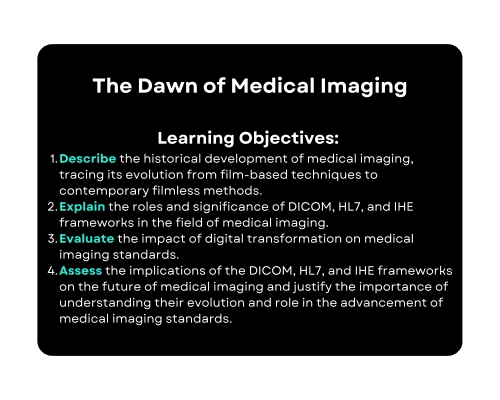
Embark on a captivating journey through the history of medical breakthroughs in our course segment: "The Dawn of Medical Imaging".
This compelling section invites learners to explore the monumental discovery of X-rays by Wilhelm Roentgen in 1895, an innovation that revolutionized medical diagnostics and opened the doors to the era of modern medical imaging. Witness the swift evolution from the initial commercial use of X-rays to the creation of the world's first radiology department. The journey extends through the introduction of ultrasound in the 1940s, the development of CT scans in the 1970s, and culminates in the groundbreaking advent of MRI, leading all the way to the introduction of the digital age and the establishment of medical imaging standards.
Interoperability Standards and Interoperability:
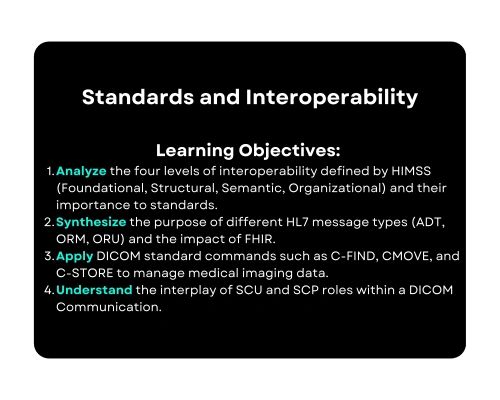
Dive into the core of healthcare technology with our "Standards and Interoperability" section, a vital part of our course designed to illuminate the intricate web of standards that enable seamless and efficient healthcare delivery. This fascinating segment unravels the mystery behind the critical frameworks that ensure diverse healthcare IT systems can communicate and work together effectively.
Starting with the foundational levels set by HIMSS, moving through the evolution of Health Level 7 (HL7) standards, and culminating in the advent of Fast Healthcare Interoperability Resources (FHIR™), this section provides an in-depth examination of the frameworks that support the exchange, integration, sharing, and retrieval of essential electronic health information. It highlights how HL7 standards have been instrumental in defining the landscape of healthcare data exchange and underscores the role of FHIR™ in advancing the interoperability upon which modern healthcare systems depend.
Additionally, discover the DICOM standard, the fundamental element of medical imaging information exchange. This section delves into the technical facets of DICOM, presenting the DICOM hierarchy, service commands, and the vital importance of unique identifiers. These components are essential for efficiently managing and navigating the extensive array of medical imaging data.
Imaging Workflow
Embark on a transformative exploration of "Medical Imaging Workflow," a pivotal section of our course designed to demystify the complexities of imaging processes within healthcare.
This critical module explores the orchestration of various systems, including Hospital Information Systems (HIS), Picture Archiving and Communication Systems (PACS), and Radiology Information Systems (RIS), extending beyond to encompass the entire spectrum of healthcare IT infrastructure. It emphasizes the indispensable role of standards such as DICOM and HL7 in boosting efficiency and precision in patient care. The module highlights the DICOM Modality Worklist's pivotal function in ensuring every image is accurately linked to its corresponding patient, thus minimizing errors and enhancing patient safety. Additionally, it introduces advanced topics such as Modality Performed Procedure Step (MPPS) and Integrating the Healthcare Enterprise (IHE) profiles, including Image Object Change Management (IOCM) and Encounter-Based Imaging Workflow (EBIW). These elements are crucial for the seamless integration of HIS, PACS, RIS, and imaging modalities, facilitated by DICOM and HL7 standards, ensuring a fluid flow of patient information from registration through to image capture, storage, and analysis. This intricate coordination does more than streamline workflows; it significantly bolsters patient care by facilitating timely and accurate diagnoses.
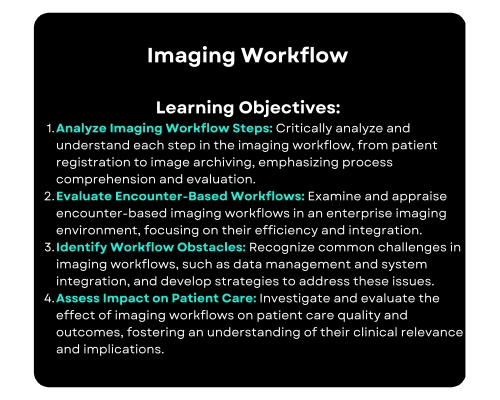
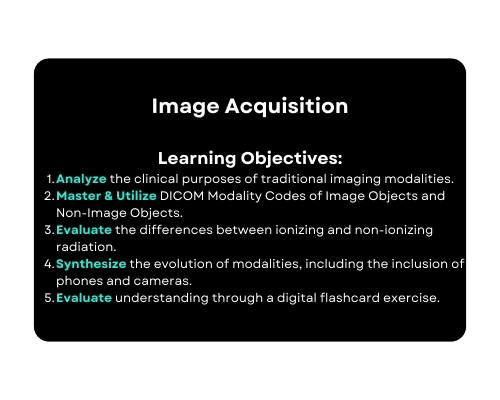
Image Aquisition
Dive into the fundamentals of medical imaging, covering everything from the diagnostic power of ionizing X-rays to the detailed views provided by non-ionizing MRI and Ultrasound. This section not only underlines DICOM's pivotal role in ensuring interoperability and data accuracy across diverse platforms but also broadens the scope to include the purpose of each modality and its impact on data storage. Furthermore, we introduce enterprise imaging acquisition, a strategy that facilitates the capture and integration of images from multiple sources without the need for a specific order, optimizing workflow and patient care. The exploration looks further into the Encounters Based Imaging Workflow (EBIW), illustrating its necessity in streamlining processes and enhancing efficiency within the healthcare ecosystem. Through this detailed examination, gain valuable insights into the technological advancements and standards shaping the future of comprehensive medical imaging.
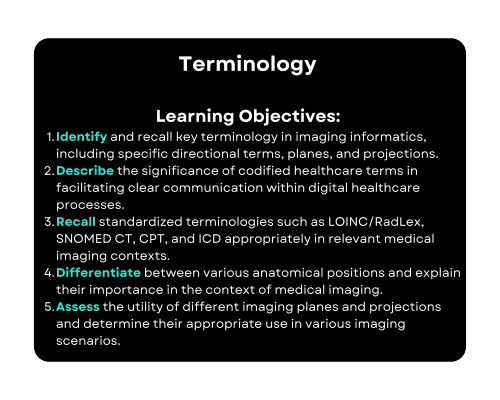
Terminology
Dive into the "Terminology" section of our course to grasp the pivotal role of precise language in healthcare, where lexicons, ontologies, and DICOM standards are foundational to accurate diagnosis and treatment. This module demystifies medical vocabulary and structures, from anatomical orientations to imaging techniques, emphasizing their importance in clear communication and interoperability. Through understanding DICOM metadata, learners gain insight into the contextual layers that enhance image interpretation. Moreover, this section underscores the significance of enterprise imaging acquisition, highlighting how standardized terminology supports comprehensive data management across healthcare systems. This essential knowledge base facilitates not only improved patient care but also fosters advancements in medical informatics, preparing learners for the complexities of modern healthcare environments.
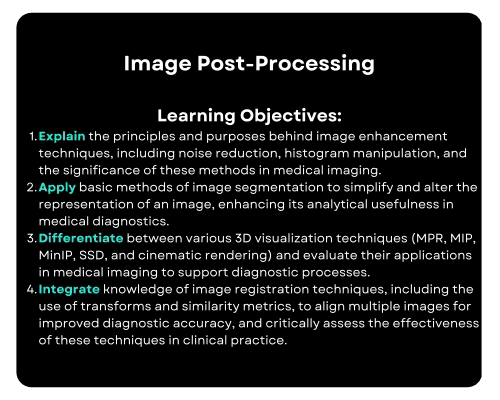
Post-Processing
In the "Image Post-Processing" section, our course delves into the transformative realm of enhancing medical images after acquisition. This critical phase in medical imaging brings to light the detailed techniques and tools that elevate diagnostic clarity, from histogram manipulation to advanced 3D visualization.
Histogram Manipulation and Enhancement form the foundation, adjusting image contrast and brightness to reveal hidden details crucial for accurate diagnosis. Techniques like Unsharp Masking and Noise Reduction further refine images, sharpening details and minimizing distractions to focus on the pathology.
Segmentation and Registration techniques are explored for their precision in isolating and aligning anatomical structures, enhancing the analysis and comparison of images over time or from different modalities. The culmination of post-processing is a look at 3D Visualization, where two-dimensional data transform into three-dimensional constructs.
Imaging AI
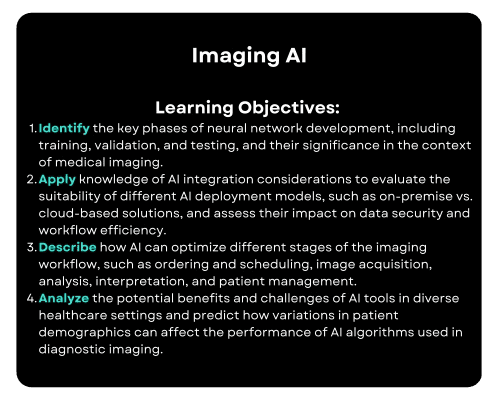
In the "AI Imaging Informatics" section of our course, we delve into the revolutionary impact of Artificial Intelligence (AI) on medical imaging, exploring everything from neural networks and workflow optimization to AI integration challenges and ethical considerations. This comprehensive module aims to illuminate the transformative potential of AI in enhancing patient care and diagnostic precision across the healthcare spectrum.
Historical Insights & Theoretical Foundations lay the groundwork, tracing AI's evolution from theoretical algorithms to the pioneering architectures that drive today's deep learning models. We examine the distinction between Artificial Intelligence, Machine Learning, and Deep Learning, clarifying their roles and synergies in advancing medical imaging technologies. AI Validation addresses the critical process of ensuring AI systems' reliability, highlighting supervised versus unsupervised learning, the phases of neural network development, and strategies to prevent model overfitting. This foundational knowledge is crucial for developing AI tools that are both effective and ethically sound. A significant focus is placed on Enhancing Radiology through AI in the Imaging Workflow, showcasing AI's role in streamlining ordering and scheduling, guiding precision in procedures, optimizing image acquisition parameters, and advancing image analysis and interpretation. This section underscores the synergy between AI analytics and human expertise, heralding a collaborative future that enhances diagnostic accuracy and patient care.
Post-Class Activities: Conclude your journey with a reflective survey, a comprehensive 15-question quiz, and a certificate of achievement, marking your foray into the imaging informatics field.
Dive into the enriching post-class activities following our comprehensive course, designed to solidify your newfound knowledge and skills. After engaging with our interactive content, you'll be invited to test your understanding through a 16-question knowledge assessment. Successfully navigating this assessment not only marks the culmination of your learning journey but also rewards you with a certificate of completion. This certificate serves as tangible recognition of your commitment to mastering the course material, readying you for real-world applications and further professional development in the field.
The Forefront of Healthcare Technology
IMG_101 is more than just a course; it's a gateway to a world of opportunities. Whether you're a fresh graduate, a seasoned professional pivoting into this niche, or an individual aiming for the CIIP designation, IMG_101 is your steppingstone to success.
Embrace the future with open arms. Enroll in IMG_101 and be part of the vanguard shaping the next frontier of healthcare technology.